Disclosure: These views are my own and do not represent any current or former employer. This paper uses public research and documentation. It does not describe non-public infrastructure or incident records.
Evidence status: The companion study uses twelve constructed repair cases in a local Python process laboratory. Its HTTP requests, process restarts and SQLite operations execute for real. Its services, configuration layers, credentials and incidents are constructed for the experiment. No autonomous agent is evaluated. The results are examples of verification scope, not estimates of production failure rates.
Executive summary
An infrastructure agent changes a running process and reports that the service is fixed. A client transaction succeeds. The next restart reads the unchanged configuration and brings the incident back.
Human operators and deterministic scripts can make the same mistake. A repair needs to be checked against the system, regardless of who produced it.
InfraBench evaluates functional, durability and cleanup obligations separately. Its reported pass rates are 91.5%, 80.9% and 38.9%, respectively. These are different check populations, so subtracting them does not measure how many initially successful repairs later failed.[1]
InfraBench includes restart and persistence checks. Replaybook verifies repairs after service restarts and a full host reboot. SWEOps-Bench tests deployed repairs against fault-specific and regression checks.[1][3][4]
This paper proposes a repair-acceptance record that binds a candidate to its target, configuration, preservation obligations, required lifecycle tests, observed results and expiry conditions. The record keeps missing baselines and untested transitions visible alongside passing checks.
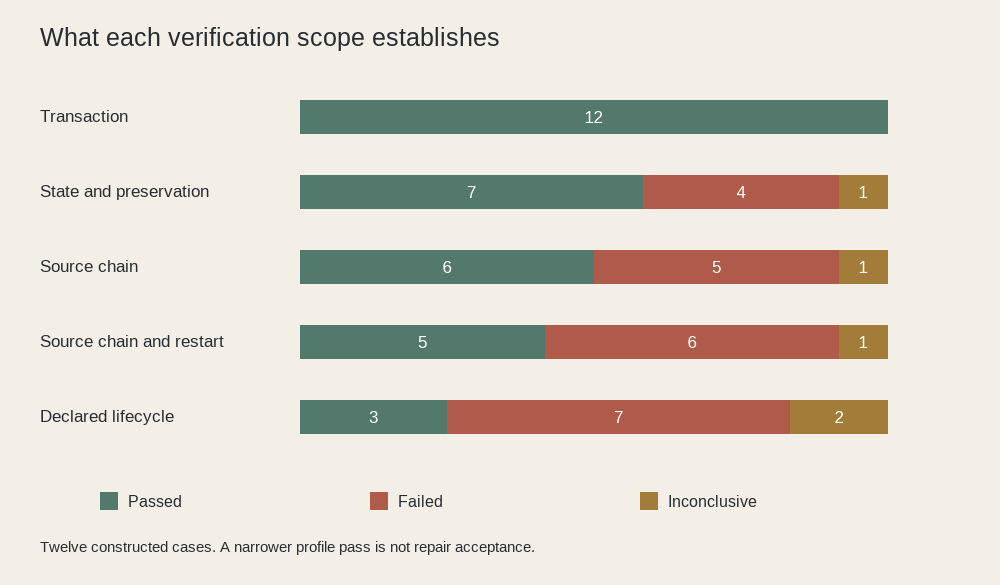
The companion study compares five nested verification scopes across twelve constructed cases. Every case first passes a write-and-read transaction after repair. State agreement, operational declarations and historical-data checks identify four of the seven deliberately introduced violations. Comparing the packaged release with the source identifies a fifth before any restart. Restart and credential rotation each expose one more under the selected profiles. Reconciliation and replacement add no new rejections after those earlier checks. Three valid controls pass the complete declared sequence. Two cases remain inconclusive because required evidence or authorisation is missing.
The study contains 300 trials: twelve cases, five scopes and five repetitions. The repetitions check implementation consistency and record local verification time. Each uses the same twelve constructed cases.
The remaining restart and rotation failures are also visible in the service's launch arguments and credential-loading setting. The study does not establish that those transition tests outperform application-aware configuration checks. It shows how the chosen evidence changes an acceptance decision and how an omitted cheap check can exaggerate the apparent value of a later test.
A downloadable review template and a worked deployment handoff show how to use the procedure with an existing change process. Untested events remain outside the acceptance claim.
1. Recovery and repair acceptance are different decisions
Incident response should restore service quickly.
Google's SRE Workbook defines incident resolution in terms of mitigating impact or restoring the previous service condition. Its incident-management guidance also separates operational response from longer-term work.[13] A temporary workaround can therefore be the right response, even when a permanent change remains outstanding.
Failover, replacement and rotation tests can themselves disrupt a recovering service. Requiring them all before declaring recovery could prolong the incident.
Record three decisions separately:
| Decision | Evidence needed | Work that can remain |
|---|---|---|
| Service recovered | User-facing behaviour has recovered over an appropriate observation window. | Root-cause correction, cleanup and future-transition evidence. |
| Temporary mitigation accepted | Recovery is observed; the workaround's limits, owner and expiry are recorded. | A permanent repair and any tests unsafe to perform during the incident. |
| Repair accepted within scope | The named candidate satisfies the required checks for a defined environment and transition set. | Untested conditions, continuing monitoring and later revalidation. |
These decisions can be recorded using an organisation's existing incident statuses.
A process-only hotfix can qualify as a temporary mitigation. Permanent repair acceptance would still need persistence evidence.
For example, an operator might accept a live configuration override until the next maintenance window. The record should identify which operations would invalidate the workaround, who owns the permanent correction and what to do if the workaround expires first.
2. What the current research establishes
2.1 InfraBench measures unfinished obligations
InfraBench revision 4 evaluates eighteen agent-model configurations on twelve seed tasks, with three attempts per task. The tasks span containers, VM clusters and bare-metal environments.[1]
Its lifecycle analysis reports:
| Obligation category | Checks passed | Checks evaluated | Pass rate |
|---|---|---|---|
| Functional | 1,276 | 1,395 | 91.5% |
| Durability | 131 | 162 | 80.9% |
| Cleanup | 189 | 486 | 38.9% |
These categories have different denominators and task mixes. They do not track the same repaired systems through successive stages.[1]
The 10.6 percentage-point difference between the first two rates is therefore not a measured probability of recurrence after apparent recovery.
Cleanup observations come from two tasks: Pelican and Slurm/Puppet. They include an uncleared incident marker and deployment or configuration residue. Those are valid obligations, although their consequences differ from data loss or a recurring outage.[1]
The benchmark shows why functional recovery and operational completion need separate checks.
It does not establish how often production agents leave fragile repairs, whether they do so more often than people, or what verification budget an organisation should adopt.
The public InfraBench repository provides task packages and verifiers. Its README says the Syscraft end-to-end evaluation runtime is not yet published.[2] Reproducing the complete campaign therefore requires additional runtime work.
2.2 The relevant mechanisms already exist
| Work | Implemented capability relevant to this paper | Boundary |
|---|---|---|
| InfraBench | Separate immediate, live, restart/durability and decommission gates, with task-specific preservation checks. | Gates are unevenly represented in the current seed suite.[1] |
| Replaybook | Controller-owned verification before and after service restart and host reboot. | Passing means satisfying the selected scenario's checks.[3] |
| SWEOps-Bench | Historical operator defects, deployed source repairs, fault-clearance checks, fix-specific tests and regression tests. | Its incident-resolution lifecycle is not a claim of exhaustive future-transition coverage.[4] |
| Acto and Sieve | Automatic state-transition or perturbation-based testing of Kubernetes controllers. | Controller testing differs from accepting an arbitrary live repair.[5][6] |
| OAT research | Tests interactions between operators and their managed applications; reports 86 new bugs across six operators. | It studies operator reliability rather than the acceptance of an agent's repair.[7] |
| Anvil | Formal verification of eventually stable reconciliation for selected controller implementations. | Its proofs depend on the verified program, model and assumptions.[8] |
Replaybook's verify_repair_lifecycle implementation checks the immediate
repair, restarts relevant services, rechecks, reboots the host, waits for
recovery and rechecks again.[3]
Argo CD compares declared and live state, with self-healing behaviour controlled by configuration. Argo Rollouts supports analysis that can allow, pause or abort a rollout. Chaos Mesh provides serial and parallel fault workflows with custom checks and conditional branches.[9][10][11]
The acceptance problem arises when those tools produce evidence for different candidates, environments or times. A record needs to show which results apply to the repair being accepted.
3. Define the claim before choosing the tests
"The fix is durable" leaves too much unspecified.
A testable claim names the changed subject, the required behaviour and the transitions that the repair is expected to tolerate.
The acceptance claim should identify the candidate, environment,
required invariants and finite transition sequence T:
Did the identified candidate satisfy the required checks
before and after each authorised transition in T,
within the declared observation and recovery limits?
The result applies to that environment and sequence. Other workloads or transition orders need separate evidence.
3.1 Follow the sources that can recreate the system
A repair may involve several configuration layers:
authoritative source
    -> rendered or applied configuration
    -> running process

packaged release
    -> replacement instance

dependency state
    -> credentials and connections used by the process
Agreement along the first chain does not establish agreement with the replacement path.
A Git working tree can contain the corrected configuration while the release used for replacement remains unchanged. A running process can also retain a value that differs from the file a restart will read.
Kubernetes' ConfigMap documentation illustrates a familiar instance: values injected as environment variables do not change inside an existing Pod merely because the source ConfigMap changes. Mounted configuration also needs appropriate application reload behaviour.[12] The exact loading path determines the relevant transition.
3.2 Make preservation independent of new work
A successful new transaction says little about historical data.
A service can accept a new write after losing an older record. A queue can process fresh messages after dropping the pre-incident backlog. Checking only fresh work can therefore reward a repair that discarded the state it was supposed to preserve.
The preservation obligation needs a reference. Depending on the system, that might be an acknowledged-message ledger, a storage snapshot, application-level checksums or a constrained set of pre-incident records. The reference itself needs an identity and an acquisition time.
Without that reference, preservation remains unverified. The verifier cannot determine whether historical state was preserved or lost.
3.3 Test the intended operating policy
Credential rotation procedures differ between systems.
Some systems require a running process to reload credentials without a rollout. Others coordinate credential changes with replacement of every client. A startup-cached credential may satisfy the second policy.
The companion study requires live credential reload. It updates the credential delivery file and restarts the dependency while the application continues running. Under this contract, a process using a startup-cached credential fails when the credential changes. A coordinated client rollout would require a different test.
Restart ordering, failover deadlines and permitted temporary degradation also belong in the contract. Tests need to match those operating conditions.
4. A repair-acceptance record
A repair-acceptance record can be attached to a deployment, change request or incident follow-up.
| Field | What the record needs to identify |
|---|---|
| Target | Environment, workload identity, ownership and relevant dependency identities. |
| Candidate | Source revision, release artifact, rendered configuration and permitted runtime overrides. |
| Obligations | Service behaviour, historical-state preservation and required operational controls. |
| Lifecycle scope | Named transitions, ordering, prerequisites and recovery deadlines. |
| Verification plan | Probe versions, observation windows, data references and required authorisations. |
| Evidence | Check results, timestamps, observations and links to immutable supporting records. |
| Decision | Accepted within scope, rejected, or inconclusive. |
| Validity | Tested subject identity, contract version, expiry and material-change triggers. |
| Residual work | Untested conditions, temporary exceptions, accountable owner and next action. |
This is a proposed production record. The local artifact implements a smaller subset: a per-trial target identity, configuration fingerprint, protocol and verifier digests, ordered checks, observations, decision and expiry. Organisational ownership, production adapters, signed storage and workflow integration are outside the implementation.
The review template provides the operational fields for a manual change review. It does not authorise tests or enforce production permissions.
4.1 Keep the decision rules small
The study uses the following rules:
- An observed violation of a required invariant fails the profile.
Remaining checks are marked
not-run. - With no observed violation, a missing or unperformed required check produces an inconclusive profile.
- A profile passes only when every required check passes.
- Only the complete declared-lifecycle profile can issue an accepted
repair receipt. A narrower profile produces
scope-only.
A confirmed violation takes precedence over an earlier unknown. For example, a missing data baseline should not conceal a later demonstrated failure after replacement.
An inconclusive result needs an owner and a next action. That might mean retaining a temporary mitigation, requesting permission for an experiment or obtaining the missing baseline. Assign those tasks explicitly before another repair attempt.
4.2 Independence has several parts
Reviewing an agent's explanation with another model does not check the repaired system. That needs a probe the repair producer cannot alter.
The repair producer should not be able to redefine the invariant, replace its baseline, modify the verifier or write its own accepted receipt. Production enforcement needs permissions and storage boundaries outside the agent's authority.
The laboratory runs the service subprocesses separately from the Python controller, which holds the reference observations. All processes run under the same user, and the complete source is public. This arrangement does not isolate a hostile privileged agent.
5. The executable case study
5.1 Environment and repair construction
The study uses only Python's standard library. The captured campaign used Python 3.12.2 on Windows 11.
Each trial creates a fresh temporary directory, an SQLite database, a backend HTTP process and an application HTTP process. Both servers bind only to loopback addresses on locally allocated ports. No container runtime, cloud account or model API is used.
The backend holds three pre-incident records in one table. New transaction probes use a separate table. The application forwards writes and reads to the configured backend and supplies a credential.
Before applying each candidate, the controller starts the same broken application configuration and confirms that a transaction fails. It then applies the selected repair and starts verification.
Each case specifies configuration and state changes for the repair. The service reads the supplied files and process arguments; it does not receive a case identifier or a pass/fail label.
| Case | Constructed condition |
|---|---|
| Source repair | Desired, active and packaged configurations point to the working backend. |
| Equivalent rendering | The active JSON file uses different whitespace with the same values. |
| Alternate valid route | Active and packaged configuration use the documented backend alias while the source retains its primary name. |
| Memory hotfix | Only the first process launch overrides the broken persisted configuration. |
| Disk hotfix | The active file is corrected while its authoritative source remains wrong. |
| Stale release | Desired and active files are corrected; the replacement package remains wrong. |
| Cached credential | The repair uses a startup-cached credential under a live-reload rotation obligation. |
| Historical record loss | New transactions work after one pre-incident record is deleted. |
| Controller disabled | The required reconciliation-enabled declaration remains false. |
| Monitoring disabled | The required monitoring-enabled declaration remains false. |
| Missing baseline | The system works, but the verifier lacks its pre-incident reference records. |
| Rotation not authorised | The system works, but the required rotation test is not permitted. |
The two enabled declarations are policy fixtures. The study does not run a monitoring stack or Kubernetes reconciliation controller. Its reconciliation operation copies the authoritative file and restarts the application. Its replacement operation starts a process from the packaged release configuration.
5.2 Verification scopes
The scopes are nested:
| Profile | Required evidence |
|---|---|
| Transaction | A write through the application is acknowledged, then read back with the expected value. |
| State and preservation | Transaction, desired/active configuration agreement, both enabled declarations, and comparison of pre-incident records with the reference. |
| Source chain | State and preservation checks, plus agreement between the desired configuration and packaged release. |
| Source chain and restart | Source-chain checks, then application restart from the active file and repeated transaction and preservation checks. |
| Declared lifecycle | All preceding checks, then reconciliation, replacement from the release package, and credential rotation with dependency restart. Transaction and preservation checks follow each transition. |
The transaction profile checks a committed write and readback through the application.
Configuration comparisons parse JSON and normalise the service's two documented names for the same backend. Different whitespace or an equivalent backend alias therefore does not create false drift. This normalisation is specific to the fixture; it is not a general method for proving that arbitrary endpoints are equivalent.
The source-chain profile extends configuration inspection to the packaged release. It catches a stale release before the replacement process is started.
Results apply to the specific checks listed here. A policy engine, GitOps controller or integration suite could be configured to perform additional checks.
5.3 Isolation, repetition and analysis
Each case-profile-repetition combination starts from a new fixture. One profile cannot improve or damage the environment later used by another profile.
The protocol specifies five repetitions and shuffles trial order within each repetition using a recorded seed. It yields:
12 cases x 5 profiles x 5 repetitions = 300 trials
The verifier decides from observations. The case catalogue's expected labels are used afterwards to check whether the implementation behaved as intended.
The analysis validates source and raw-record digests, checks that every scheduled trial is present, rejects duplicate combinations and checks for variable outcomes before producing the case table.
Every case-profile combination produced the same outcome across all five repetitions in the final campaign.
5.4 Development history and the stronger baseline
The first complete development campaign produced one unexpected transaction failure in the monitoring-disabled case. The application reported a dependency-request timeout under its original one-second forwarding deadline. The other four repetitions of that case-profile combination passed.
Before the final campaign, dependency preflight was added. The application's request timeout was increased to five seconds and the controller's to six seconds. A complete four-profile campaign of 240 new trials was then captured.
A later method review found that the four-profile comparison omitted a cheap check of the packaged release. That omission made replacement testing appear to add a finding that a source-to-release comparison could already provide.
Protocol 1.1.0 adds the source-chain profile and includes its release comparison before restart and lifecycle testing. It also strengthens the valid-alias control and receipt validation. The final campaign contains 300 newly executed trials under that protocol.
Both earlier 240-trial campaigns remain in the bundle: the initial timeout-affected development run and the subsequent four-profile run. The latter includes its exact analyser. Their records are kept separate from the final campaign. The protocol records both amendments.
The revised deadlines are laboratory settings. Production timeouts need separate justification.
6. Results
6.1 State checks find four violations
The case-level outcomes are:
| Verification profile | Passed | Failed | Inconclusive |
|---|---|---|---|
| Transaction | 12 | 0 | 0 |
| State and preservation | 7 | 4 | 1 |
| Source chain | 6 | 5 | 1 |
| Source chain and restart | 5 | 6 | 1 |
| Declared lifecycle | 3 | 7 | 2 |
Each row covers the same twelve authored cases. Counts are shown rather than percentages because the catalogue deliberately includes valid repairs, known violations and evidence gaps. Its composition is not a failure-frequency estimate.
State checks find the active/source divergence and the two disabled operational declarations. The historical-data check finds the missing record. These four violations need no disruptive lifecycle experiment.
The missing-baseline case becomes inconclusive at the same stage. The record exists in the system, but the verifier cannot establish its preservation from an unavailable reference.
6.2 The stronger baseline changes the incremental finding
The source-chain comparison rejects the stale-release case without starting a replacement. Restart then exposes the memory-only hotfix: the original process has a working override, while its successor reads the broken active file.
The first confirmed findings are:
| Added check or transition | Newly rejected cases |
|---|---|
| State agreement, declarations and preservation | 4 |
| Packaged-release comparison | 1 |
| Restart | 1 |
| Reconciliation | 0 |
| Replacement | 0 |
| Credential rotation | 1 |
The cached-credential case passes restart because startup reads the still-current credential again. It fails the specified rotation sequence, which retains the running application after changing the delivered credential.
Reconciliation and replacement remain required transitions in the full profile. Neither is the first rejecting check for a case after the stronger source-chain inspection.
Both remaining mechanisms are visible to a policy written specifically for this small service. Such a policy could reject an undeclared launch override or require file-loaded credentials. The experiment therefore does not establish that executing transitions is necessary to detect these known defects. It demonstrates the coverage of the selected checks and the effect of strengthening their baseline.
The rotation-not-authorised case remains unresolved after every permitted step succeeds. Skipping the rotation cannot produce a complete pass.
The three valid controls pass every profile. This includes the semantically equivalent rendering and configurations that use different supported names for the same backend across layers. The verifier does not require byte-for-byte reproduction of a reference repair.
The three controls show that the verifier accepts these valid alternatives. They are too few to estimate a production false-positive rate.
6.3 Verification time is local and scope-dependent
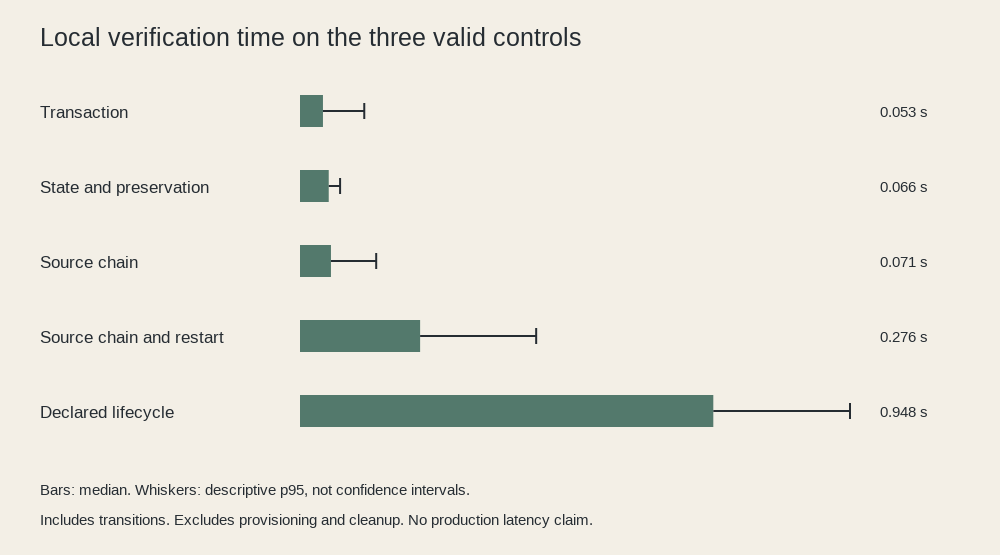
The following measurements use only the same three valid controls. Each profile therefore has fifteen timing observations. This avoids making broader verification appear cheaper merely because more failing cases stop early.
| Profile | Median verification time | Descriptive p95 |
|---|---|---|
| Transaction | 0.053 s | 0.147 s |
| State and preservation | 0.066 s | 0.092 s |
| Source chain | 0.071 s | 0.175 s |
| Source chain and restart | 0.276 s | 0.542 s |
| Declared lifecycle | 0.948 s | 1.262 s |
The timer starts with the first post-repair probe. It includes the tested transitions and waits, and excludes initial provisioning, incident reproduction, repair setup, final process cleanup and analysis.
These fifteen observations per profile describe this run. They do not establish a performance ranking that transfers to another machine or service.
A real replacement can involve image transfer, scheduling, storage attachment, cache warming, leader election and external health convergence. None of those costs is represented by starting this small Python process.
Production verification time and cost remain unmeasured.
7. Evidence expires when its subject changes
Every acceptance receipt should identify the tested configuration and the conditions that would invalidate it.
The artifact emits a receipt containing a unique target identifier, a fingerprint before verification, a final subject fingerprint, the protocol and verifier digests, the ordered check observations and timestamps for verification start, completion and expiry. The captured example comes from the source-repair control.
Its configuration fingerprint covers the desired, active and release files, operational declarations, credential delivery files, application configuration source, any launch override, baseline availability, rotation permission and service implementation digest.
The final fingerprint differs legitimately from the initial one when verification changes credentials or the application's configuration source. The receipt therefore binds acceptance to the resulting subject.
The artifact's assess_receipt function refuses an acceptance claim when:
- the receipt belongs to a narrower profile;
- the protocol digest differs;
- the verifier implementation digest differs;
- a required check is missing, duplicated, reordered or unsuccessful;
- the supplied current subject fingerprint differs;
- the timestamps are invalid, precede completion or exceed the permitted lifetime.
The completion timestamp is collected after the checks and final fingerprint. The illustrative fifteen-minute lifetime starts there. The receipt also records when verification began, so the duration is visible. Suitability of that lifetime for a production service remains untested.
The prototype does not enforce a separate maximum age for each observation. A production plan would need that limit when checks can take materially different amounts of time.
Production validity should account for events as well as elapsed time. A new release, a changed dependency contract, an untested region or a different storage class can invalidate earlier evidence immediately. A time limit alone will miss those changes.
Hashes identify the bytes associated with a record. Authenticating the author and observations requires separate controls. Detecting later changes requires fresh observations of the target. The example receipts are unsigned and refer to temporary laboratory targets that no longer exist.
A production adapter would need authoritative target identities, trusted acquisition of current state and access-controlled evidence storage. Monitoring needs to cover the period between acceptance and the next change.
Receipt validation checks the stored claim's scope and freshness. It does not probe the live service again or establish that historical data has remained intact since the last preservation check.
8. Use existing tools before adding another layer
An organisation can adopt the acceptance procedure without building the whole laboratory or replacing its delivery system.
Start with one consequential repair class. Identify the authoritative source, the running state, the replacement path and the historical data that must remain intact.
Reuse available evidence. A valid GitOps comparison can satisfy a declared-state obligation. A deployment analysis can provide a bounded service observation. An existing integration or recovery test can cover a required restart or failover transition.[9][10]
Attach those results to the same candidate and target. Record the conditions under which each result was collected.
Then look for the untested boundary. In one service it may be a replacement image. In another it may be secret rotation, restoration from backup or failover to a secondary region. Choose transitions from the service's operating requirements and the state changed by the repair.
8.1 Order checks by consequence as well as cost
State inspection and baseline comparison should usually precede a disruptive experiment. Reject a candidate with a known violation before starting a disruptive test.
| Check class | Useful placement | Required caution |
|---|---|---|
| Source, release and policy inspection | Before accepting or exercising the candidate. | Know which source is authoritative and which fields are intentionally different. |
| Historical-state preservation | Before potentially destructive validation and after relevant transitions. | Preserve the baseline; do not let repair overwrite it. |
| Restart or replacement | Disposable environment, canary or approved maintenance operation. | Define availability bounds, dependencies and stop conditions. |
| Failover, restore or rotation | Environment and action scope explicitly authorised for that test. | A failed experiment can create a second incident. |
A shadow environment can reduce risk while missing production-specific dependencies. A canary can preserve those dependencies while limiting the sample. The record should state which compromise was made.
The study implements a fixed sequence. It does not implement automatic transition selection, dependency-graph discovery or a risk optimiser.
8.2 Assign an owner to missing checks
In the rotation-not-authorised case, report that transactions, state, restart, reconciliation and replacement passed and rotation remains untested. The owner can then obtain an approved environment or agree a different operating policy.
For temporary mitigations, retain a deadline and the event that would invalidate the workaround. An incident commander can declare service recovered while a separate owner remains responsible for the permanent repair and its missing evidence.
8.3 A worked deployment handoff
Consider a hypothetical catalog-api deployment whose ConfigMap
contains the wrong backend endpoint. This is an illustrative review
example, separate from the measured process study. No Kubernetes
deployment was run for this paper.
Assume the source configuration and rendered release have been corrected. GitOps reports them synchronised. One newly created canary Pod has completed a write-and-read transaction.
That result still needs a scope. Kubernetes does not update an existing Pod's environment variables when the source ConfigMap changes. A deployment can contain Pods with different loaded values until they are replaced.[12] GitOps synchronisation alone cannot establish what every application process has loaded.[9]
The handoff could record:
| Obligation | Evidence assumed in this example | Decision supported |
|---|---|---|
| Correct source and release | Recorded Git revision and rendered manifests agree on the endpoint. | Source-chain agreement for that candidate. |
| A fresh instance can serve | A named canary Pod passed the transaction probe using the corrected configuration. | Recovery observed for that Pod. |
| All required replicas can serve | No per-replica or deployment-wide transaction evidence has been collected. | Deployment-wide recovery remains unverified. |
| Pre-incident state is preserved | The required historical-data reference is unavailable. | Preservation remains inconclusive. |
The deployment-wide repair decision is inconclusive. The canary result remains useful evidence, with the canary's workload identity attached. It should not be relabelled as evidence for every replica.
Assign the service on-call role to collect the required deployment-wide observation and work with the data owner on the preservation reference. Record a real deadline and the permitted temporary mitigation in the existing change or incident record.
The candidate revision, image digest, configuration revision and probe version belong in that record. Changes to them require the evidence to be reviewed again. Disruptive checks still need the organisation's normal authorisation.
This example needs a fresh-Pod check because its claim depends on configuration loaded at process creation. It adds no host-reboot or credential-rotation requirement. Those tests belong in the plan only when the service's operating obligations or the proposed change require them.
The plain-text review template can be copied into a change request. It leaves the owner, deadline, required checks and authorisations blank for the reviewer to supply.
9. Report verification coverage
This catalogue deliberately includes seven known violations. Detecting them under tests designed for their mechanisms provides no estimate of detection on unseen infrastructure failures.
Report the following measures:
| Measure | Unit and interpretation |
|---|---|
| Profile outcomes | Passed, failed and inconclusive counts over the same named cases. |
| Incremental findings | Cases first rejected by each added check, including zero-yield steps. |
| Required-check coverage | Which checks ran, which did not, and why. |
| Control behaviour | Whether known valid alternatives were wrongly rejected. |
| Verification time | Local elapsed time under a stated timing boundary. |
| Receipt validity | Whether subject, scope and freshness conditions still match. |
An evaluation of actual autonomous repairs would need another sampling protocol. It would have to name the agent, model, tools, permissions, budgets, incidents and intervention policy, and retain every attempted repair under those rules.
For N attempts with H immediate successes, report H/N. If D of
those immediate successes complete every required verification check,
report D/N across all attempts and D/H among immediate successes.
Report D/H as undefined when H is zero.
Confirmed latent violations, inconclusive outcomes and unperformed checks should remain separate. A missing result must not silently count as either a durable repair or a demonstrated failure.
The sampling protocol and environment determine how far those rates can be generalised. The constructed cases here support no population estimate.
10. The strongest counterargument
Experienced SRE teams already test deployments, preserve data, reconcile configuration and track follow-up work. An additional acceptance document could become another box to tick.
An organisation whose existing systems already bind results to the candidate and target, retain unknowns and invalidate stale evidence may need no additional record.
Autonomous work can cross those systems and return one success statement. A completed agent run, a successful API call, a green deployment and a verified repair describe different events.
The appropriate implementation may be a small change to an existing release or incident record. The amount of process should follow the consequence of accepting the wrong repair.
The study illustrates the procedure. A specialist can predict most outcomes by inspecting the files, and executing the cases checks that the implementation behaves as described. It introduces no new verification algorithm.
11. What remains unproven
The study evaluates constructed repairs. Comparisons with autonomous agents, human repair, agent self-review or another model's review would require additional experiments.
Cases were chosen to demonstrate specific failure mechanisms. The resulting corpus cannot estimate latent-failure prevalence, detection sensitivity or false-rejection rates in production.
The environment has no real Kubernetes controller, VM reboot, cloud failover, replica scheduler, storage attachment or distributed concurrency. Its replacement operation is a fresh local application process using another configuration file.
The preservation checks observe a fixed historical record set at checkpoints. They do not prove that no transient violation occurred between observations. Arbitrary future workloads and different transition orders remain untested.
The enabled declarations check configuration only. Monitoring and controller liveness remain untested.
The verifier is not isolated from a hostile actor with the same privileges. Receipts are unsigned, and fingerprints cannot provide authority by themselves.
Incident recurrence, customer impact and operational cost were not measured. The study establishes no optimum verification budget, expiry period or transition-selection policy.
Conclusion
A passing transaction establishes a useful fact about the current system. Accepting a repair requires deciding what else the organisation is relying on.
In the constructed catalogue, inexpensive state and preservation checks find four violations before any restart. Including the packaged release finds a fifth. Restart and rotation each add one finding under the selected profiles; reconciliation and replacement add none.
The comparison also exposes its own limit: service-specific configuration rules could recognise the remaining defects in this small fixture. Record which checks passed, under which conditions and for which target. Keep untested obligations, validity conditions and an accountable owner alongside the result.
Reproducibility
The study bundle contains the paper, protocol, case definitions, service and controller code, focused tests, raw observations, generated tables, figures and the retained development and earlier four-profile campaigns. It also includes the manual review template.
The primary records are final trial observations, the case matrix and exact summary values. Source digests and the runtime description are in the run manifest. The protocol records the development and method amendments.
From the downloaded artifact directory:
python -B -m unittest -v test_study
python -B study.py --output reproduced
python -B analyse.py reproduced
Use a new output directory. The runner refuses to overwrite a campaign. The study needs Python 3.12 or later and available loopback ports. It uses no external network service and installs no packages.
Generated timings, timestamps and target identifiers will differ. The reference outcomes describe the declared cases, and inconsistent repetitions must be investigated rather than averaged away.
See the artifact README for the execution boundary, file map and exact interpretation of the records.
About the author
Jason Doyle writes about reliable software systems and applied AI. He publishes at jasondoyle.ie.
References
-
Yuan Gao and colleagues, InfraBench: Evaluating Infrastructure Agents Across Layers, Lifecycle, and Risk, arXiv:2608.11234v4, revised 18 October 2026. Sections 2.3, 4.3, 6 and Appendix E. Paper.
-
InfraBench project, Public task packages and evaluation runtime, README at commit
49158e6166fc6082bd89bd5c4d837e3762591ea2, accessed 24 November 2026. README. -
Replaybook project, Host-native repair lifecycle verification,
integrations/host/run-host-native.sh, lines 665-746, commit20a281049c1ab7d0629a90f7eb66066c69e14cc9, 21 November 2026. Implementation. -
Danwen Chen, Guangba Yu and Pengfei Chen, SWEOps-Bench: Evaluating Agents for End-to-End Resolution of Software-Induced Cloud Incidents, arXiv:2611.06099v1, submitted 4 November 2026. Sections 3.3-3.5. Paper.
-
Acto project, Push-Button End-to-End Testing of Kubernetes Operators and Controllers, README and SOSP 2023 paper, accessed 24 November 2026. Repository.
-
Xudong Sun and colleagues, Automatic Reliability Testing For Cluster Management Controllers, OSDI 2022. Publication.
-
Jiawei Tyler Gu and colleagues, Who Watches the Watchers? On the Reliability of Softwarizing Cloud Application Management, NSDI 2026. Publication.
-
Xudong Sun and colleagues, Anvil: Verifying Liveness of Cluster Management Controllers, OSDI 2024. Publication.
-
Argo CD project, Automated Sync Policy, accessed 24 November 2026. Documentation.
-
Argo Rollouts project, Analysis and Progressive Delivery, accessed 24 November 2026. Documentation.
-
Chaos Mesh project, Create Chaos Mesh Workflow, accessed 24 November 2026. Documentation.
-
Kubernetes project, Updating Configuration via a ConfigMap, accessed 24 November 2026. Documentation.
-
Jennifer Mace, Jelena Oertel, Stephen Thorne and Arup Chakrabarti, Incident Response, The Site Reliability Workbook, chapter 9. Chapter.