# Accepting an Autonomous Infrastructure Repair
## Evidence after service recovery
Author: Jason Doyle
Published: 25 November 2026
Version: 1.1.0
Status: Self-published technical report; not peer reviewed.
Licensing: Report text, original data and figures are CC BY 4.0.
Supporting Python software is licensed under MIT.
See [LICENSES.txt](./LICENSES.txt).
Archived version: [10.5281/zenodo.24545813](https://doi.org/10.5281/zenodo.24545813)
Version: 1.1.0
Status: Self-published technical report; not peer reviewed.
Licence: Report text and archival renderings are licensed under CC BY 4.0; supporting files use the terms in the archived LICENSES.txt.
> Disclosure: These views are my own and do not represent any current or
> former employer. This paper uses public research and documentation.
> It does not describe non-public infrastructure or incident records.
> Evidence status: The companion study uses twelve constructed repair
> cases in a local Python process laboratory. Its HTTP requests, process
> restarts and SQLite operations execute for real. Its services,
> configuration layers, credentials and incidents are constructed for the
> experiment. No autonomous agent is evaluated. The results are examples
> of verification scope, not estimates of production failure rates.
## Executive summary
An infrastructure agent changes a running process and reports that the
service is fixed. A client transaction succeeds. The next restart reads
the unchanged configuration and brings the incident back.
Human operators and deterministic scripts can make the same mistake.
A repair needs to be checked against the system, regardless of who
produced it.
InfraBench evaluates functional, durability and cleanup obligations
separately. Its reported pass rates are 91.5%, 80.9% and 38.9%,
respectively. These are different
check populations, so subtracting them does not measure how many initially
successful repairs later failed.[1]
InfraBench includes restart and persistence checks. Replaybook verifies
repairs after service restarts and a full host reboot. SWEOps-Bench tests
deployed repairs against fault-specific and regression checks.[1][3][4]
This paper proposes a repair-acceptance record that binds a candidate to
its target, configuration, preservation obligations, required lifecycle
tests, observed results and expiry conditions. The record keeps missing
baselines and untested transitions visible alongside passing checks.
The companion study compares five nested verification scopes across
twelve constructed cases. Every case first passes a write-and-read
transaction after repair. State agreement, operational declarations and
historical-data checks identify four of the seven deliberately introduced
violations. Comparing the packaged release with the source identifies a
fifth before any restart. Restart and credential rotation each expose
one more under the selected profiles. Reconciliation and replacement add
no new rejections after those earlier checks.
Three valid controls pass the complete declared sequence. Two cases
remain inconclusive because required evidence or authorisation is
missing.
The study contains 300 trials: twelve cases, five scopes and five
repetitions. The repetitions check implementation consistency and record
local verification time. Each uses the same twelve constructed cases.
The remaining restart and rotation failures are also visible in the
service's launch arguments and credential-loading setting. The study
does not establish that those transition tests outperform
application-aware configuration checks. It shows how the chosen evidence
changes an acceptance decision and how an omitted cheap check can
exaggerate the apparent value of a later test.
A downloadable review template and a worked deployment handoff show how
to use the procedure with an existing change process. Untested events
remain outside the acceptance claim.
## 1. Recovery and repair acceptance are different decisions
Incident response should restore service quickly.
Google's SRE Workbook defines incident resolution in terms of mitigating
impact or restoring the previous service condition. Its incident-management
guidance also separates operational response from longer-term work.[13]
A temporary workaround can therefore be the right response, even when a
permanent change remains outstanding.
Failover, replacement and rotation tests can themselves disrupt a
recovering service. Requiring them all before declaring recovery could
prolong the incident.
Record three decisions separately:
| Decision | Evidence needed | Work that can remain |
| --- | --- | --- |
| Service recovered | User-facing behaviour has recovered over an appropriate observation window. | Root-cause correction, cleanup and future-transition evidence. |
| Temporary mitigation accepted | Recovery is observed; the workaround's limits, owner and expiry are recorded. | A permanent repair and any tests unsafe to perform during the incident. |
| Repair accepted within scope | The named candidate satisfies the required checks for a defined environment and transition set. | Untested conditions, continuing monitoring and later revalidation. |
These decisions can be recorded using an organisation's existing
incident statuses.
A process-only hotfix can qualify as a temporary mitigation. Permanent
repair acceptance would still need persistence evidence.
For example, an operator might accept a live configuration override until
the next maintenance window. The record should identify which operations
would invalidate the workaround, who owns the permanent correction and
what to do if the workaround expires first.
## 2. What the current research establishes
### 2.1 InfraBench measures unfinished obligations
InfraBench revision 4 evaluates eighteen agent-model configurations on
twelve seed tasks, with three attempts per task. The tasks span containers,
VM clusters and bare-metal environments.[1]
Its lifecycle analysis reports:
| Obligation category | Checks passed | Checks evaluated | Pass rate |
| --- | --- | --- | --- |
| Functional | 1,276 | 1,395 | 91.5% |
| Durability | 131 | 162 | 80.9% |
| Cleanup | 189 | 486 | 38.9% |
These categories have different denominators and task mixes. They do
not track the same repaired systems through successive stages.[1]
The 10.6 percentage-point difference between the first two rates is
therefore not a measured probability of recurrence after apparent
recovery.
Cleanup observations come from two tasks: Pelican and Slurm/Puppet.
They include an uncleared incident marker and deployment or
configuration residue. Those are valid obligations,
although their consequences differ from data loss or a recurring
outage.[1]
The benchmark shows why functional recovery and operational completion
need separate checks.
It does not establish how often production agents leave fragile repairs,
whether they do so more often than people, or what verification budget an
organisation should adopt.
The public InfraBench repository provides task packages and verifiers.
Its README says the Syscraft end-to-end evaluation runtime is not yet
published.[2] Reproducing the complete campaign therefore requires
additional runtime work.
### 2.2 The relevant mechanisms already exist
| Work | Implemented capability relevant to this paper | Boundary |
| --- | --- | --- |
| InfraBench | Separate immediate, live, restart/durability and decommission gates, with task-specific preservation checks. | Gates are unevenly represented in the current seed suite.[1] |
| Replaybook | Controller-owned verification before and after service restart and host reboot. | Passing means satisfying the selected scenario's checks.[3] |
| SWEOps-Bench | Historical operator defects, deployed source repairs, fault-clearance checks, fix-specific tests and regression tests. | Its incident-resolution lifecycle is not a claim of exhaustive future-transition coverage.[4] |
| Acto and Sieve | Automatic state-transition or perturbation-based testing of Kubernetes controllers. | Controller testing differs from accepting an arbitrary live repair.[5][6] |
| OAT research | Tests interactions between operators and their managed applications; reports 86 new bugs across six operators. | It studies operator reliability rather than the acceptance of an agent's repair.[7] |
| Anvil | Formal verification of eventually stable reconciliation for selected controller implementations. | Its proofs depend on the verified program, model and assumptions.[8] |
Replaybook's `verify_repair_lifecycle` implementation checks the immediate
repair, restarts relevant services, rechecks, reboots the host, waits for
recovery and rechecks again.[3]
Argo CD compares declared and live state, with self-healing behaviour
controlled by configuration. Argo Rollouts supports analysis that can
allow, pause or abort a rollout. Chaos Mesh provides serial and parallel
fault workflows with custom checks and conditional branches.[9][10][11]
The acceptance problem arises when those tools produce evidence for
different candidates, environments or times. A record needs to show which
results apply to the repair being accepted.
## 3. Define the claim before choosing the tests
"The fix is durable" leaves too much unspecified.
A testable claim names the changed subject, the required behaviour and
the transitions that the repair is expected to tolerate.
The acceptance claim should identify the candidate, environment,
required invariants and finite transition sequence `T`:
```text
Did the identified candidate satisfy the required checks
before and after each authorised transition in T,
within the declared observation and recovery limits?
```
The result applies to that environment and sequence. Other workloads or
transition orders need separate evidence.
### 3.1 Follow the sources that can recreate the system
A repair may involve several configuration layers:
```text
authoritative source
-> rendered or applied configuration
-> running process
packaged release
-> replacement instance
dependency state
-> credentials and connections used by the process
```
Agreement along the first chain does not establish agreement with the
replacement path.
A Git working tree can contain the corrected configuration while the
release used for replacement remains unchanged. A running process can
also retain a value that differs from the file a restart will read.
Kubernetes' ConfigMap documentation illustrates a familiar instance:
values injected as environment variables do not change inside an
existing Pod merely because the source ConfigMap changes. Mounted
configuration also needs appropriate application reload behaviour.[12]
The exact loading path determines the relevant transition.
### 3.2 Make preservation independent of new work
A successful new transaction says little about historical data.
A service can accept a new write after losing an older record. A queue
can process fresh messages after dropping the pre-incident backlog.
Checking only fresh work can therefore reward a repair that discarded
the state it was supposed to preserve.
The preservation obligation needs a reference. Depending on the system,
that might be an acknowledged-message ledger, a storage snapshot,
application-level checksums or a constrained set of pre-incident records.
The reference itself needs an identity and an acquisition time.
Without that reference, preservation remains unverified. The verifier
cannot determine whether historical state was preserved or lost.
### 3.3 Test the intended operating policy
Credential rotation procedures differ between systems.
Some systems require a running process to reload credentials without a
rollout. Others coordinate credential changes with replacement of every
client. A startup-cached credential may satisfy the second policy.
The companion study requires live credential reload. It updates the
credential delivery file and restarts the dependency while the
application continues running. Under this contract, a process using a
startup-cached credential fails when the credential changes. A
coordinated client rollout would require a different test.
Restart ordering, failover deadlines and permitted temporary degradation
also belong in the contract. Tests need to match those operating
conditions.
## 4. A repair-acceptance record
A repair-acceptance record can be attached to a deployment, change
request or incident follow-up.
| Field | What the record needs to identify |
| --- | --- |
| Target | Environment, workload identity, ownership and relevant dependency identities. |
| Candidate | Source revision, release artifact, rendered configuration and permitted runtime overrides. |
| Obligations | Service behaviour, historical-state preservation and required operational controls. |
| Lifecycle scope | Named transitions, ordering, prerequisites and recovery deadlines. |
| Verification plan | Probe versions, observation windows, data references and required authorisations. |
| Evidence | Check results, timestamps, observations and links to immutable supporting records. |
| Decision | Accepted within scope, rejected, or inconclusive. |
| Validity | Tested subject identity, contract version, expiry and material-change triggers. |
| Residual work | Untested conditions, temporary exceptions, accountable owner and next action. |
This is a proposed production record. The local artifact implements a
smaller subset: a per-trial target identity, configuration fingerprint,
protocol and verifier digests, ordered checks, observations, decision
and expiry.
Organisational ownership, production adapters, signed storage and
workflow integration are outside the implementation.
The [review template](./repair-acceptance-template.txt) provides the
operational fields for a manual change review. It does not authorise
tests or enforce production permissions.
### 4.1 Keep the decision rules small
The study uses the following rules:
1. An observed violation of a required invariant fails the profile.
Remaining checks are marked `not-run`.
2. With no observed violation, a missing or unperformed required check
produces an inconclusive profile.
3. A profile passes only when every required check passes.
4. Only the complete declared-lifecycle profile can issue an accepted
repair receipt. A narrower profile produces `scope-only`.
A confirmed violation takes precedence over an earlier unknown. For
example, a missing data baseline should not conceal a later demonstrated
failure after replacement.
An inconclusive result needs an owner and a next action. That might mean
retaining a temporary mitigation, requesting permission for an experiment
or obtaining the missing baseline. Assign those tasks explicitly before
another repair attempt.
### 4.2 Independence has several parts
Reviewing an agent's explanation with another model does not check the
repaired system. That needs a probe the repair producer cannot alter.
The repair producer should not be able to redefine the invariant,
replace its baseline, modify the verifier or write its own accepted
receipt. Production enforcement needs permissions and storage boundaries
outside the agent's authority.
The laboratory runs the service subprocesses separately from the Python
controller, which holds the reference observations. All processes run
under the same user, and the complete source is public. This arrangement
does not isolate a hostile privileged agent.
## 5. The executable case study
### 5.1 Environment and repair construction
The study uses only Python's standard library. The captured campaign
used Python 3.12.2 on Windows 11.
Each trial creates a fresh temporary directory, an SQLite database, a
backend HTTP process and an application HTTP process. Both servers bind
only to loopback addresses on locally allocated ports. No container
runtime, cloud account or model API is used.
The backend holds three pre-incident records in one table. New transaction
probes use a separate table. The application forwards writes and reads to
the configured backend and supplies a credential.
Before applying each candidate, the controller starts the same broken
application configuration and confirms that a transaction fails. It then
applies the selected repair and starts verification.
Each case specifies configuration and state changes for the repair.
The service reads the supplied files and process arguments; it does not
receive a case identifier or a pass/fail label.
| Case | Constructed condition |
| --- | --- |
| Source repair | Desired, active and packaged configurations point to the working backend. |
| Equivalent rendering | The active JSON file uses different whitespace with the same values. |
| Alternate valid route | Active and packaged configuration use the documented backend alias while the source retains its primary name. |
| Memory hotfix | Only the first process launch overrides the broken persisted configuration. |
| Disk hotfix | The active file is corrected while its authoritative source remains wrong. |
| Stale release | Desired and active files are corrected; the replacement package remains wrong. |
| Cached credential | The repair uses a startup-cached credential under a live-reload rotation obligation. |
| Historical record loss | New transactions work after one pre-incident record is deleted. |
| Controller disabled | The required reconciliation-enabled declaration remains false. |
| Monitoring disabled | The required monitoring-enabled declaration remains false. |
| Missing baseline | The system works, but the verifier lacks its pre-incident reference records. |
| Rotation not authorised | The system works, but the required rotation test is not permitted. |
The two enabled declarations are policy fixtures. The study does not run
a monitoring stack or Kubernetes reconciliation controller. Its
reconciliation operation copies the authoritative file and restarts the
application. Its replacement operation starts a process from the packaged
release configuration.
### 5.2 Verification scopes
The scopes are nested:
| Profile | Required evidence |
| --- | --- |
| Transaction | A write through the application is acknowledged, then read back with the expected value. |
| State and preservation | Transaction, desired/active configuration agreement, both enabled declarations, and comparison of pre-incident records with the reference. |
| Source chain | State and preservation checks, plus agreement between the desired configuration and packaged release. |
| Source chain and restart | Source-chain checks, then application restart from the active file and repeated transaction and preservation checks. |
| Declared lifecycle | All preceding checks, then reconciliation, replacement from the release package, and credential rotation with dependency restart. Transaction and preservation checks follow each transition. |
The transaction profile checks a committed write and readback through the
application.
Configuration comparisons parse JSON and normalise the service's two
documented names for the same backend. Different whitespace or an
equivalent backend alias therefore does not create false drift. This
normalisation is specific to the fixture; it is not a general method for
proving that arbitrary endpoints are equivalent.
The source-chain profile extends configuration inspection to the
packaged release. It catches a stale release before the replacement
process is started.
Results apply to the specific checks listed here. A policy engine,
GitOps controller or integration suite could be configured to perform
additional checks.
### 5.3 Isolation, repetition and analysis
Each case-profile-repetition combination starts from a new fixture.
One profile cannot improve or damage the environment later used by
another profile.
The protocol specifies five repetitions and shuffles trial order within
each repetition using a recorded seed. It yields:
```text
12 cases x 5 profiles x 5 repetitions = 300 trials
```
The verifier decides from observations. The case catalogue's expected
labels are used afterwards to check whether the implementation behaved
as intended.
The analysis validates source and raw-record digests, checks that every
scheduled trial is present, rejects duplicate combinations and checks for
variable outcomes before producing the case table.
Every case-profile combination produced the same outcome across all
five repetitions in the final campaign.
### 5.4 Development history and the stronger baseline
The first complete development campaign produced one unexpected
transaction failure in the monitoring-disabled case. The application
reported a dependency-request timeout under its original one-second
forwarding deadline. The other four repetitions of that case-profile
combination passed.
Before the final campaign, dependency preflight was added. The
application's request timeout was increased to five seconds and the
controller's to six seconds. A complete four-profile campaign of 240
new trials was then captured.
A later method review found that the four-profile comparison omitted a
cheap check of the packaged release. That omission made replacement
testing appear to add a finding that a source-to-release comparison
could already provide.
Protocol 1.1.0 adds the source-chain profile and includes its release
comparison before restart and lifecycle testing. It also strengthens the
valid-alias control and receipt validation. The final campaign contains
300 newly executed trials under that protocol.
Both earlier 240-trial campaigns remain in the bundle: the initial
timeout-affected development run and the subsequent four-profile run.
The latter includes its exact analyser. Their records are kept separate
from the final campaign. The protocol records both amendments.
The revised deadlines are laboratory settings. Production timeouts need
separate justification.
## 6. Results
### 6.1 State checks find four violations
The case-level outcomes are:
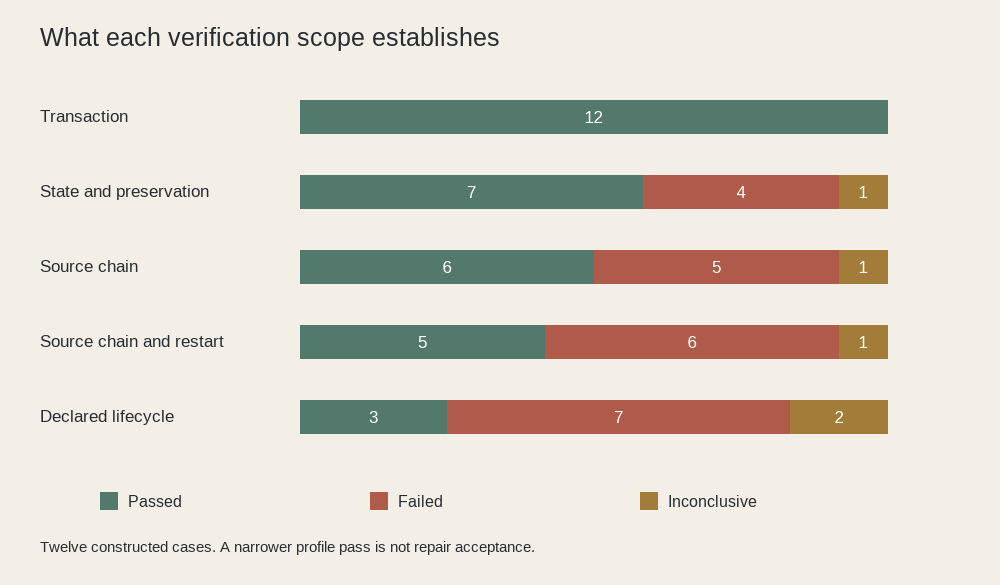
| Verification profile | Passed | Failed | Inconclusive |
| --- | --- | --- | --- |
| Transaction | 12 | 0 | 0 |
| State and preservation | 7 | 4 | 1 |
| Source chain | 6 | 5 | 1 |
| Source chain and restart | 5 | 6 | 1 |
| Declared lifecycle | 3 | 7 | 2 |
Each row covers the same twelve authored cases. Counts are shown rather
than percentages because the catalogue deliberately includes valid
repairs, known violations and evidence gaps. Its composition is not a
failure-frequency estimate.
State checks find the active/source divergence and the two disabled
operational declarations. The historical-data check finds the missing
record. These four violations need no disruptive lifecycle experiment.
The missing-baseline case becomes inconclusive at the same stage.
The record exists in the system, but the verifier cannot establish its
preservation from an unavailable reference.
Figure 1. Broader scopes expose additional obligations in the same constructed catalogue. A narrower profile pass is not repair acceptance. Download the per-case table.
### 6.2 The stronger baseline changes the incremental finding
The source-chain comparison rejects the stale-release case without
starting a replacement. Restart then exposes the memory-only hotfix:
the original process has a working override, while its successor reads
the broken active file.
The first confirmed findings are:
| Added check or transition | Newly rejected cases |
| --- | --- |
| State agreement, declarations and preservation | 4 |
| Packaged-release comparison | 1 |
| Restart | 1 |
| Reconciliation | 0 |
| Replacement | 0 |
| Credential rotation | 1 |
The cached-credential case passes restart because startup reads the
still-current credential again. It fails the specified rotation
sequence, which retains the running application after changing the
delivered credential.
Reconciliation and replacement remain required transitions in the full
profile. Neither is the first rejecting check for a case after the
stronger source-chain inspection.
Both remaining mechanisms are visible to a policy written specifically
for this small service. Such a policy could reject an undeclared launch
override or require file-loaded credentials. The experiment therefore
does not establish that executing transitions is necessary to detect
these known defects. It demonstrates the coverage of the selected
checks and the effect of strengthening their baseline.
The rotation-not-authorised case remains unresolved after every permitted
step succeeds. Skipping the rotation cannot produce a complete pass.
The three valid controls pass every profile. This includes the
semantically equivalent rendering and configurations that use different
supported names for the same backend across layers.
The verifier does not require byte-for-byte reproduction of a reference
repair.
The three controls show that the verifier accepts these valid
alternatives. They are too few to estimate a production false-positive
rate.
### 6.3 Verification time is local and scope-dependent
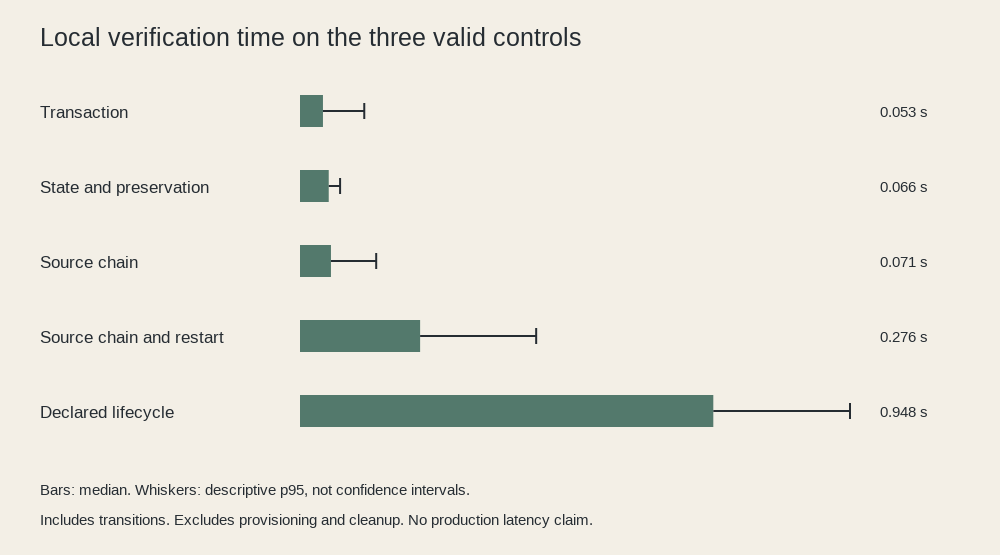
The following measurements use only the same three valid controls.
Each profile therefore has fifteen timing observations. This avoids
making broader verification appear cheaper merely because more failing
cases stop early.
| Profile | Median verification time | Descriptive p95 |
| --- | --- | --- |
| Transaction | 0.053 s | 0.147 s |
| State and preservation | 0.066 s | 0.092 s |
| Source chain | 0.071 s | 0.175 s |
| Source chain and restart | 0.276 s | 0.542 s |
| Declared lifecycle | 0.948 s | 1.262 s |
The timer starts with the first post-repair probe. It includes the tested
transitions and waits, and excludes initial provisioning, incident
reproduction, repair setup, final process cleanup and analysis.
These fifteen observations per profile describe this run. They do not
establish a performance ranking that transfers to another machine or
service.
Figure 2. Bars show medians and whiskers show descriptive p95 values, not confidence intervals. These are local process timings, not production restart, failover or incident-resolution times. Download exact values.
A real replacement can involve image transfer, scheduling, storage
attachment, cache warming, leader election and external health
convergence. None of those costs is represented by starting this small
Python process.
Production verification time and cost remain unmeasured.
## 7. Evidence expires when its subject changes
Every acceptance receipt should identify the tested configuration and
the conditions that would invalidate it.
The artifact emits a receipt containing a unique target identifier, a
fingerprint before verification, a final subject fingerprint, the
protocol and verifier digests, the ordered check observations and
timestamps for verification start, completion and expiry.
The [captured example](./artifact/results/example-receipt.json) comes from
the source-repair control.
Its configuration fingerprint covers the desired, active and release
files, operational declarations, credential delivery files, application
configuration source, any launch override, baseline availability,
rotation permission and service implementation digest.
The final fingerprint differs legitimately from the initial one when
verification changes credentials or the application's configuration
source. The receipt therefore binds acceptance to the resulting subject.
The artifact's `assess_receipt` function refuses an acceptance claim when:
- the receipt belongs to a narrower profile;
- the protocol digest differs;
- the verifier implementation digest differs;
- a required check is missing, duplicated, reordered or unsuccessful;
- the supplied current subject fingerprint differs;
- the timestamps are invalid, precede completion or exceed the permitted
lifetime.
The completion timestamp is collected after the checks and final
fingerprint. The illustrative fifteen-minute lifetime starts there.
The receipt also records when verification began, so the duration is
visible. Suitability of that lifetime for a production service remains
untested.
The prototype does not enforce a separate maximum age for each
observation. A production plan would need that limit when checks can
take materially different amounts of time.
Production validity should account for events as well as elapsed time.
A new release, a changed dependency contract, an untested region or a
different storage class can invalidate earlier evidence immediately.
A time limit alone will miss those changes.
Hashes identify the bytes associated with a record. Authenticating the
author and observations requires separate controls. Detecting later
changes requires fresh observations of the target. The example receipts
are unsigned and refer to temporary laboratory targets that no longer
exist.
A production adapter would need authoritative target identities,
trusted acquisition of current state and access-controlled evidence
storage. Monitoring needs to cover the period between acceptance and
the next change.
Receipt validation checks the stored claim's scope and freshness. It
does not probe the live service again or establish that historical data
has remained intact since the last preservation check.
## 8. Use existing tools before adding another layer
An organisation can adopt the acceptance procedure without building the
whole laboratory or replacing its delivery system.
Start with one consequential repair class. Identify the authoritative
source, the running state, the replacement path and the historical data
that must remain intact.
Reuse available evidence. A valid GitOps comparison can satisfy a
declared-state obligation. A deployment analysis can provide a bounded
service observation. An existing integration or recovery test can cover
a required restart or failover transition.[9][10]
Attach those results to the same candidate and target. Record the
conditions under which each result was collected.
Then look for the untested boundary. In one service it may be a
replacement image. In another it may be secret rotation, restoration
from backup or failover to a secondary region. Choose transitions from
the service's operating requirements and the state changed by the repair.
### 8.1 Order checks by consequence as well as cost
State inspection and baseline comparison should usually precede a
disruptive experiment. Reject a candidate with a known violation before
starting a disruptive test.
| Check class | Useful placement | Required caution |
| --- | --- | --- |
| Source, release and policy inspection | Before accepting or exercising the candidate. | Know which source is authoritative and which fields are intentionally different. |
| Historical-state preservation | Before potentially destructive validation and after relevant transitions. | Preserve the baseline; do not let repair overwrite it. |
| Restart or replacement | Disposable environment, canary or approved maintenance operation. | Define availability bounds, dependencies and stop conditions. |
| Failover, restore or rotation | Environment and action scope explicitly authorised for that test. | A failed experiment can create a second incident. |
A shadow environment can reduce risk while missing production-specific
dependencies. A canary can preserve those dependencies while limiting
the sample. The record should state which compromise was made.
The study implements a fixed sequence. It does not implement automatic
transition selection, dependency-graph discovery or a risk optimiser.
### 8.2 Assign an owner to missing checks
In the rotation-not-authorised case, report that transactions, state,
restart, reconciliation and replacement passed and rotation remains
untested. The owner can then obtain an approved environment or agree a
different operating policy.
For temporary mitigations, retain a deadline and the event that would
invalidate the workaround. An incident commander can declare service
recovered while a separate owner remains responsible for the permanent
repair and its missing evidence.
### 8.3 A worked deployment handoff
Consider a hypothetical `catalog-api` deployment whose ConfigMap
contains the wrong backend endpoint. This is an illustrative review
example, separate from the measured process study. No Kubernetes
deployment was run for this paper.
Assume the source configuration and rendered release have been
corrected. GitOps reports them synchronised. One newly created canary
Pod has completed a write-and-read transaction.
That result still needs a scope. Kubernetes does not update an existing
Pod's environment variables when the source ConfigMap changes. A
deployment can contain Pods with different loaded values until they are
replaced.[12] GitOps synchronisation alone cannot establish what every
application process has loaded.[9]
The handoff could record:
| Obligation | Evidence assumed in this example | Decision supported |
| --- | --- | --- |
| Correct source and release | Recorded Git revision and rendered manifests agree on the endpoint. | Source-chain agreement for that candidate. |
| A fresh instance can serve | A named canary Pod passed the transaction probe using the corrected configuration. | Recovery observed for that Pod. |
| All required replicas can serve | No per-replica or deployment-wide transaction evidence has been collected. | Deployment-wide recovery remains unverified. |
| Pre-incident state is preserved | The required historical-data reference is unavailable. | Preservation remains inconclusive. |
The deployment-wide repair decision is inconclusive. The canary result
remains useful evidence, with the canary's workload identity attached.
It should not be relabelled as evidence for every replica.
Assign the service on-call role to collect the required deployment-wide
observation and work with the data owner on the preservation reference.
Record a real deadline and the permitted temporary mitigation in the
existing change or incident record.
The candidate revision, image digest, configuration revision and probe
version belong in that record. Changes to them require the evidence to
be reviewed again. Disruptive checks still need the organisation's
normal authorisation.
This example needs a fresh-Pod check because its claim depends on
configuration loaded at process creation. It adds no host-reboot or
credential-rotation requirement. Those tests belong in the plan only
when the service's operating obligations or the proposed change require
them.
The [plain-text review template](./repair-acceptance-template.txt) can be
copied into a change request. It leaves the owner, deadline, required
checks and authorisations blank for the reviewer to supply.
## 9. Report verification coverage
This catalogue deliberately includes seven known violations. Detecting
them under tests designed for their mechanisms provides no estimate of
detection on unseen infrastructure failures.
Report the following measures:
| Measure | Unit and interpretation |
| --- | --- |
| Profile outcomes | Passed, failed and inconclusive counts over the same named cases. |
| Incremental findings | Cases first rejected by each added check, including zero-yield steps. |
| Required-check coverage | Which checks ran, which did not, and why. |
| Control behaviour | Whether known valid alternatives were wrongly rejected. |
| Verification time | Local elapsed time under a stated timing boundary. |
| Receipt validity | Whether subject, scope and freshness conditions still match. |
An evaluation of actual autonomous repairs would need another sampling
protocol. It would have to name the agent, model, tools, permissions,
budgets, incidents and intervention policy, and retain every attempted
repair under those rules.
For `N` attempts with `H` immediate successes, report `H/N`. If `D` of
those immediate successes complete every required verification check,
report `D/N` across all attempts and `D/H` among immediate successes.
Report `D/H` as undefined when `H` is zero.
Confirmed latent violations, inconclusive outcomes and unperformed
checks should remain separate. A missing result must not silently count
as either a durable repair or a demonstrated failure.
The sampling protocol and environment determine how far those rates can
be generalised. The constructed cases here support no population estimate.
## 10. The strongest counterargument
Experienced SRE teams already test deployments, preserve data, reconcile
configuration and track follow-up work. An additional acceptance
document could become another box to tick.
An organisation whose existing systems already bind results to the
candidate and target, retain unknowns and invalidate stale evidence may
need no additional record.
Autonomous work can cross those systems and return one success statement.
A completed agent run, a successful API call, a green deployment and a
verified repair describe different events.
The appropriate implementation may be a small change to an existing
release or incident record. The amount of process should follow the
consequence of accepting the wrong repair.
The study illustrates the procedure. A specialist can predict most
outcomes by inspecting the files, and executing the cases checks that
the implementation behaves as described. It introduces no new
verification algorithm.
## 11. What remains unproven
The study evaluates constructed repairs. Comparisons with autonomous
agents, human repair, agent self-review or another model's review would
require additional experiments.
Cases were chosen to demonstrate specific failure mechanisms. The
resulting corpus cannot estimate latent-failure prevalence, detection
sensitivity or false-rejection rates in production.
The environment has no real Kubernetes controller, VM reboot, cloud
failover, replica scheduler, storage attachment or distributed
concurrency. Its replacement operation is a fresh local application
process using another configuration file.
The preservation checks observe a fixed historical record set at
checkpoints. They do not prove that no transient violation occurred
between observations. Arbitrary future workloads and different
transition orders remain untested.
The enabled declarations check configuration only. Monitoring and
controller liveness remain untested.
The verifier is not isolated from a hostile actor with the same
privileges. Receipts are unsigned, and fingerprints cannot provide
authority by themselves.
Incident recurrence, customer impact and operational cost were not
measured. The study establishes no optimum verification budget, expiry
period or transition-selection policy.
## Conclusion
A passing transaction establishes a useful fact about the current
system. Accepting a repair requires deciding what else the organisation
is relying on.
In the constructed catalogue, inexpensive state and preservation checks
find four violations before any restart. Including the packaged release
finds a fifth. Restart and rotation each add one finding under the
selected profiles; reconciliation and replacement add none.
The comparison also exposes its own limit: service-specific configuration
rules could recognise the remaining defects in this small fixture.
Record which checks passed, under which conditions and for which target.
Keep untested obligations, validity conditions and an accountable owner
alongside the result.
## Reproducibility
The [study bundle](./repair-acceptance-study.zip) contains the paper,
protocol, case definitions, service and controller code, focused tests,
raw observations, generated tables, figures and the retained development
and earlier four-profile campaigns. It also includes the manual review
template.
The primary records are [final trial observations](./artifact/results/trials.jsonl),
the [case matrix](./artifact/results/case-outcomes.csv) and
[exact summary values](./artifact/results/summary.csv). Source digests and
the runtime description are in the [run manifest](./artifact/results/manifest.json).
The [protocol](./artifact/protocol.json) records the development and
method amendments.
From the downloaded artifact directory:
```text
python -B -m unittest -v test_study
python -B study.py --output reproduced
python -B analyse.py reproduced
```
Use a new output directory. The runner refuses to overwrite a campaign.
The study needs Python 3.12 or later and available loopback ports. It uses
no external network service and installs no packages.
Generated timings, timestamps and target identifiers will differ.
The reference outcomes describe the declared cases, and inconsistent
repetitions must be investigated rather than averaged away.
See the [artifact README](./artifact/README.md) for the execution boundary,
file map and exact interpretation of the records.
## About the author
Jason Doyle writes about reliable software systems and applied AI.
He publishes at [jasondoyle.ie](https://jasondoyle.ie).
## References
1. Yuan Gao and colleagues, *InfraBench: Evaluating Infrastructure Agents
Across Layers, Lifecycle, and Risk*, arXiv:2608.11234v4, revised
18 October 2026. Sections 2.3, 4.3, 6 and Appendix E.
[Paper](https://arxiv.org/html/2608.11234v4).
2. InfraBench project, *Public task packages and evaluation runtime*,
README at commit `49158e6166fc6082bd89bd5c4d837e3762591ea2`,
accessed 24 November 2026.
[README](https://github.com/InfraBen-ch/InfraBench/blob/49158e6166fc6082bd89bd5c4d837e3762591ea2/README.md#02--evaluation-runtime).
3. Replaybook project, *Host-native repair lifecycle verification*,
`integrations/host/run-host-native.sh`, lines 665-746, commit
`20a281049c1ab7d0629a90f7eb66066c69e14cc9`, 21 November 2026.
[Implementation](https://github.com/ducks/replaybook/blob/20a281049c1ab7d0629a90f7eb66066c69e14cc9/integrations/host/run-host-native.sh#L665-L746).
4. Danwen Chen, Guangba Yu and Pengfei Chen, *SWEOps-Bench: Evaluating
Agents for End-to-End Resolution of Software-Induced Cloud Incidents*,
arXiv:2611.06099v1, submitted 4 November 2026. Sections 3.3-3.5.
[Paper](https://arxiv.org/html/2611.06099v1).
5. Acto project, *Push-Button End-to-End Testing of Kubernetes Operators
and Controllers*, README and SOSP 2023 paper, accessed
24 November 2026. [Repository](https://github.com/xlab-uiuc/acto).
6. Xudong Sun and colleagues, *Automatic Reliability Testing For Cluster
Management Controllers*, OSDI 2022.
[Publication](https://www.usenix.org/conference/osdi22/presentation/sun).
7. Jiawei Tyler Gu and colleagues, *Who Watches the Watchers? On the
Reliability of Softwarizing Cloud Application Management*, NSDI 2026.
[Publication](https://www.usenix.org/conference/nsdi26/presentation/gu).
8. Xudong Sun and colleagues, *Anvil: Verifying Liveness of Cluster
Management Controllers*, OSDI 2024.
[Publication](https://www.usenix.org/conference/osdi24/presentation/sun-xudong).
9. Argo CD project, *Automated Sync Policy*, accessed 24 November 2026.
[Documentation](https://argo-cd.readthedocs.io/en/stable/user-guide/auto_sync/).
10. Argo Rollouts project, *Analysis and Progressive Delivery*, accessed
24 November 2026.
[Documentation](https://argo-rollouts.readthedocs.io/en/stable/features/analysis/).
11. Chaos Mesh project, *Create Chaos Mesh Workflow*, accessed
24 November 2026.
[Documentation](https://chaos-mesh.org/docs/create-chaos-mesh-workflow/).
12. Kubernetes project, *Updating Configuration via a ConfigMap*,
accessed 24 November 2026.
[Documentation](https://kubernetes.io/docs/tutorials/configuration/updating-configuration-via-a-configmap/).
13. Jennifer Mace, Jelena Oertel, Stephen Thorne and Arup Chakrabarti,
*Incident Response*, The Site Reliability Workbook, chapter 9.
[Chapter](https://sre.google/workbook/incident-response/).